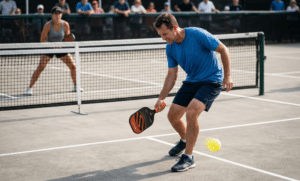
If you’ve ever felt stuck in the middle of the pickleball court, getting pounded with shots at your feet while desperately trying to reach the kitchen line, you’ve experienced the challenge of the Transition Zone in Pickleball. This critical area separates beginners from intermediate players and intermediates from advanced competitors. The transition zone in pickleball is where most rallies are won or lost, yet it’s the area players understand the least.
What Is the Transition Zone in Pickleball?
The transition zone in pickleball is the midcourt area between the baseline and the non-volley zone line. This space is commonly referred to as “No Man’s Land” because it’s an uncomfortable position where you’re vulnerable to aggressive shots from opponents.

Think of the pickleball court as having three distinct zones:
- Baseline Zone: Where you return serves and hit groundstrokes
- Transition Zone: The middle area you must navigate to advance forward
- Kitchen Line Zone: The most dominant position where most points are won
You’re not as much of a threat when positioned in the transition zone compared to when you establish yourself at the kitchen line. That’s why understanding how to move through this area efficiently is essential for improving your game.
The transition zone isn’t a place to set up camp. It’s a temporary space you must navigate strategically to reach the kitchen line, where you can control the point and put pressure on your opponents.
Why the Transition Zone in Pickleball Is So Challenging
The transition zone represents dangerous real estate where players are neither fully committed to attacking nor properly positioned to defend. Several factors make this area particularly difficult:
Limited Reaction Time: When you’re caught in the transition zone, the ball reaches you faster than when you’re at the baseline. You have less time to prepare, adjust your positioning, and execute your shot.
Vulnerable to Attack: Skilled opponents recognize when you’re stuck in the transition zone in pickleball and will aggressively target your feet with hard, low shots. These balls force you to hit upward, giving your opponents control of the point.
Awkward Shot Selection: You’re too close to the net to comfortably hit groundstrokes, but too far back to volley effectively. This creates uncertainty about which shot to execute.
Footwork Challenges: Moving forward while maintaining balance and readiness requires excellent footwork skills that many players haven’t developed.
Mental Pressure: The awareness of being in a vulnerable position creates stress, leading to rushed decisions and unforced errors.
The Three-Zone Strategy: Understanding Court Positioning
To master the transition zone in pickleball, you need to understand how all three court zones work together:
| Zone | Position | Strategy | When to Use |
|---|---|---|---|
| Baseline | Behind the court | Groundstrokes, third shot drops | After serving or when pushed back |
| Transition Zone | Mid-court | Resets, blocks, controlled shots | Moving from baseline to kitchen |
| Kitchen Line | Non-volley zone line | Volleys, dinks, aggressive attacks | Once you’ve advanced successfully |
The goal is to spend minimal time in the transition zone. Moving through this area effectively helps you gain control at the kitchen line, which is the most dominant position in pickleball.
Essential Techniques for Navigating the Transition Zone
The Split Step: Your Secret Weapon
The split step is a small, controlled hop where you land with feet slightly wider than shoulder-width apart and knees slightly bent. This fundamental technique keeps you balanced and ready to react in any direction.
Here’s how to execute the split step correctly:
- Timing: Perform your split step just as your opponent’s shot crosses the net not too early or too late
- Landing: Touch down on the balls of your feet with knees flexed and weight centered
- Stance: Keep your feet shoulder-width apart and land in a low, athletic stance
- Readiness: Stay relaxed through your legs so you can explode toward the ball in any direction
The split step allows you to adjust your position quickly without overcommitting in one direction, which is critical when navigating the transition zone in pickleball.
Body Positioning and Paddle Preparation
Your body position in the transition zone determines whether you’ll successfully advance or get stuck:

Stay Low: Bend your knees and lower your center of gravity. This athletic stance helps you react to balls hit at your feet and maintains better balance.
Wide Base: Instead of running forward to hit the ball, maintain a wide base and get low to the ground.
Paddle Up and Forward: Keep your paddle in front of your body, positioned between your chest and waist. An open paddle face (angled slightly upward) helps you redirect low balls over the net.
Contact Point: Contact the ball in front of your body, never letting it get to the side or behind you.
Weight Transfer: Keep your weight on the balls of your feet, ready to move in any direction without losing balance.
Read more: How to Become a 4.5 Pickleball Player?
The Reset Shot: Your Defensive Tool
When opponents attack you in the transition zone, the reset shot is your best defensive weapon. This soft, controlled shot neutralizes aggressive pace and lands in your opponent’s kitchen, forcing them to hit upward.
How to Execute a Reset:
- Absorb the pace rather than adding power
- Use a short backswing with a gentle follow-through
- Aim for the kitchen, preferably crosscourt
- Keep the ball low over the net
- Focus on control over power
When your opponent hits fast shots or drives as you’re moving forward, avoid trying to hit a hard return instead, block or reset the shot by softly absorbing the pace.
Strategic Movement Through the Transition Zone
Successfully navigating the transition zone requires a clear strategy and disciplined execution. Here’s your step-by-step approach:
Step 1: Move Forward After Your Shot
After hitting your shot (typically a third shot drop or a groundstroke), immediately begin moving forward. Don’t wait to see where your shot lands start advancing right away to gain ground.
Step 2: Execute Your Split Step
Just before your opponent makes contact with the ball, perform the split step. This timing is crucial for maintaining balance and readiness.
Step 3: Read the Incoming Shot
As your opponent contacts the ball, assess the shot’s trajectory, speed, and placement:
- High ball above the net: Consider an aggressive volley or controlled attack
- Ball at your feet or below the net: Execute a reset shot
- Medium-height ball: Block it back or hit a controlled return
Step 4: Advance Incrementally
Against good opponents, it typically takes two to three shots to safely work your way up to the non-volley zone line. Don’t rush advance in small steps after each successful shot.
Step 5: Establish Position at the Kitchen Line
Once you’ve successfully navigated the transition zone in pickleball, plant yourself at the kitchen line with your partner. This dominant position allows you to control the point and put pressure on your opponents.
Common Mistakes Players Make in the Transition Zone
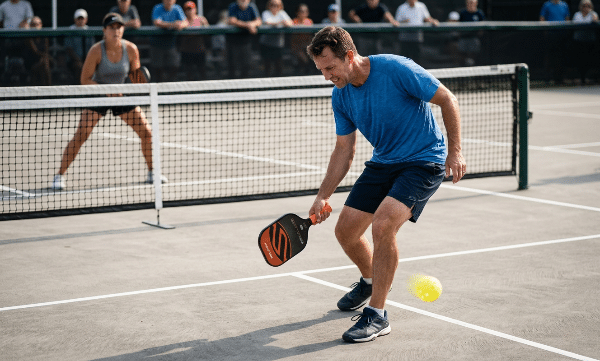
Understanding what not to do is just as important as knowing the correct techniques. Here are the most costly errors:
Mistake 1: Lingering Too Long
Staying in the transition zone for too long makes you an easy target for opponent attacks. The goal is to move through this area quickly and strategically, not to establish a position there.
Solution: Keep moving forward after each shot, using small steps and split-steps to advance safely toward the kitchen line.
Mistake 2: Standing Too Upright
Many players stand tall in the transition zone in pickleball, making it impossible to handle low shots effectively. This rigid posture also slows your reaction time.
Solution: Maintain a low, athletic stance with bent knees and weight on the balls of your feet. Think “ready position” from other sports.
Mistake 3: Rushing to the Kitchen
Sprinting to the net immediately after driving the ball usually leaves you highly vulnerable to a fast block or volley angled down at your feet.
Solution: Advance methodically, using split-steps to pause and read your opponent’s shot before continuing forward.
Read more: Pickleball Drills to Level Up Your Skills
Mistake 4: Hitting Too Aggressively
When caught in the transition zone with a ball at your feet, many players try to hit winners or aggressive drives. This typically results in hitting the ball into the net or popping it up for an easy put-away.
Solution: Accept that you’re in a defensive position and focus on resetting the ball into your opponent’s kitchen. Neutralize the point rather than trying to win it from a disadvantaged position.
Mistake 5: Poor Paddle Position
Keeping your paddle too low, too high, or behind your body prevents you from reacting quickly to shots in the transition zone.
Solution: Maintain your paddle in a neutral position in front of your chest, with an open face ready to block or reset incoming shots.
Practical Drills to Master the Transition Zone
Practice makes permanent. These drills will help you develop the skills needed to confidently navigate the transition zone in pickleball:
The 7-11 Drill
This competitive drill simulates real transition zone pressure:
One player starts at the kitchen, the other at the baseline. The baseline player must win seven points before the kitchen player wins eleven.
Focus Points:
- The baseline player must move forward with good footwork to score
- The kitchen player attacks the feet of the advancing player, forcing them into a low, lunging position
- Practice split-stepping, resetting, and advancing under pressure
This drill trains your body to move correctly when under attack, building the muscle memory needed for competitive play.
Split-Step Timing Drill
Work on perfecting your split-step timing with this focused exercise:
Move forward from the baseline and focus on split stepping right as your hitting partner makes contact, then reset the ball.
Progression:
- Start slowly with your partner feeding predictable shots
- Gradually increase the pace and vary shot placement
- Add lateral movement to simulate real game situations
- Practice until split-stepping becomes automatic
Hot Coals Drill
Think of your feet like they’re on hot coals always moving, never stuck.
How to Practice:
- Have a partner feed balls while you stay in the transition zone in pickleball
- Keep your feet constantly moving with small adjustments
- Stay low and maintain balance
- Never let your feet get planted or stuck
This drill develops the active footwork required to handle rapid-fire shots in the transition zone.
Crosscourt Reset Practice
Set up with one player at the kitchen line and one in the transition zone:
- The transition zone player practices hitting crosscourt resets
- The kitchen player works on attacking feet
- Switch roles every 5-10 minutes
- Focus on soft hands and controlled pace
Key Learning: This drill teaches you to neutralize pace while navigating forward under pressure.
Progressive Advancement Drill
This drill simulates the complete transition from baseline to kitchen:
- Start at the baseline and hit a third shot drop
- Move forward 2-3 steps and split-step
- Reset the next ball while advancing another 2-3 steps
- Continue advancing until you reach the kitchen line
- Reset and repeat
Focus: Incremental advancement, proper split-step timing, and shot selection based on ball height and pace.
Advanced Strategies for the Transition Zone
Once you’ve mastered the fundamentals, these advanced concepts will elevate your transition zone play:
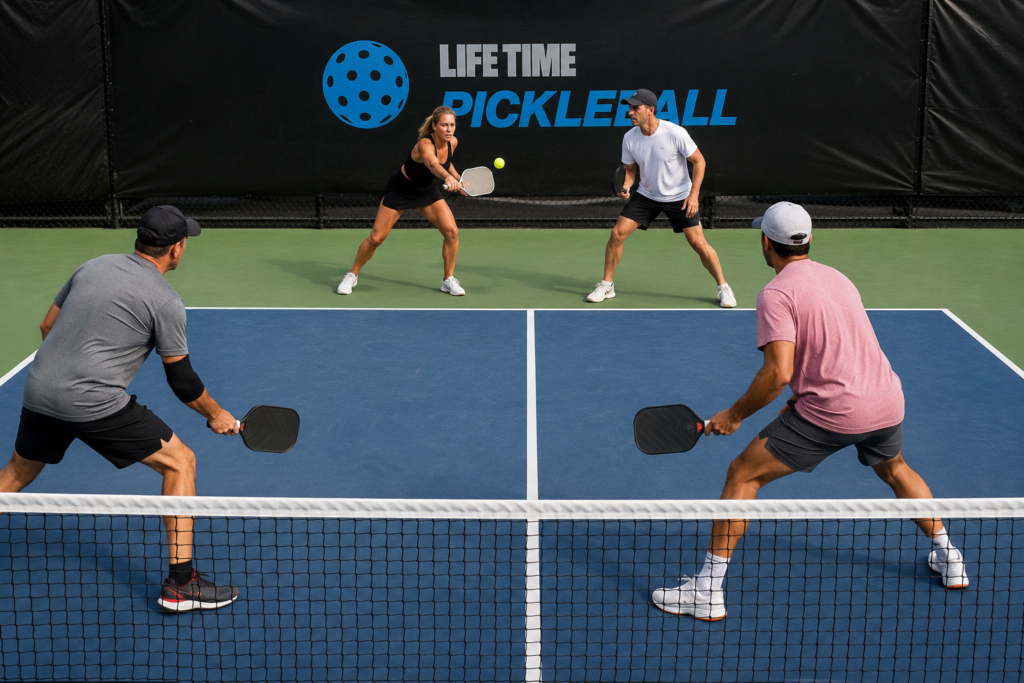
Reading Your Opponent’s Position
Before moving through the transition zone, assess your opponent’s positioning:
- Opponents at baseline: You can advance more aggressively
- Opponents at kitchen line: Expect attacks at your feet and be ready with resets
- One up, one back: Target the player at the baseline while advancing
Using the Crosscourt Angle
When resetting from the transition zone in pickleball, aim crosscourt rather than straight ahead. This creates:
- More margin for error (longer distance = more net clearance)
- Difficult angles for your opponents
- Better court positioning for you and your partner
Read more: Slinger Pickleball Machine: Train Like a Pro
The Fake Advance
Occasionally, show forward movement after your shot, then split-step and hold your position if your opponent hits a quality shot. This:
- Prevents you from running into difficult balls
- Forces opponents to make better shots
- Keeps you balanced and ready to respond
Partner Communication
In doubles, coordinate with your partner when moving through the transition zone:
- Call “Mine” or “Yours” clearly on balls down the middle
- Move forward together when possible
- Cover for each other when one player is stuck in transition
- Communicate about court positioning and shot selection
Debunking Common Misconceptions
Let’s address some widespread myths about the transition zone in pickleball:
Misconception #1: “You should never be in the transition zone”
Reality: The transition zone is unavoidable. After serving or being pushed back, you must navigate through this area to reach the kitchen. The key is minimizing the time spent there, not avoiding it entirely.
Misconception #2: “Hard drives are the best way through the transition zone”
Reality: While aggressive drives can work occasionally, they often leave you vulnerable if your opponent blocks the ball at your feet. Controlled drops and resets are more reliable for advancing safely.
Misconception #3: “You need to reach the kitchen in one shot”
Reality: Against skilled opponents, it typically takes two to three shots to safely advance to the non-volley zone line. Patience and incremental progress win more points than rushing.
Misconception #4: “The transition zone is the same in singles and doubles”
Reality: While the physical zone is identical, singles players must cover more court, making transition zone navigation more challenging. Doubles players can support each other and advance together.
Misconception #5: “Better equipment will solve transition zone problems”
Reality: While quality paddles and court shoes help, fundamental footwork and shot selection matter far more than equipment when navigating the transition zone.
Transition Zone Strategy: Singles vs. Doubles
The approach to the transition zone varies between singles and doubles play:
Singles Considerations
- Cover more court laterally, making advancement more challenging
- Face more pressure when in transition since no partner provides support
- May choose to stay back more often and play from the baseline
- Must be more selective about when to advance forward
- Recovery to the baseline is a valid strategy if caught in poor position
Doubles Strategy
- Advance with your partner to maintain formation
- Use communication to coordinate movement
- One player can cover while the other advances
- More opportunities to reach the kitchen since court coverage is shared
- Stacking formations can help partners advance more effectively
Mental Approach to the Transition Zone
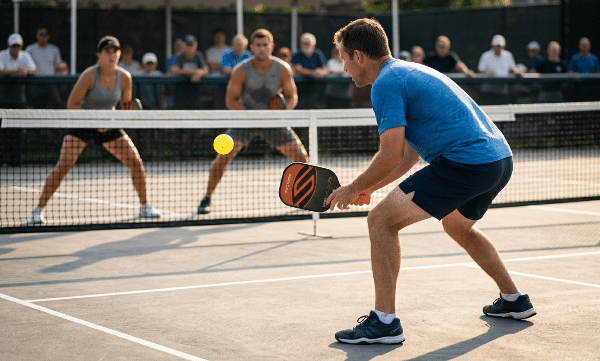
Your mindset significantly impacts your success in the transition zone. Here’s the mental framework used by advanced players:
Accept Vulnerability: Recognize that the transition zone is inherently difficult. Don’t get frustrated it’s supposed to be challenging.
Prioritize Position Over Winners: Your goal is to advance safely, not to hit spectacular shots. Control and consistency beat aggression in this zone.
Stay Patient: The transition zone is often about survival and positioning prioritize consistency and control over aggression unless you’re in a strong offensive position.
Trust Your Training: When drills have prepared you properly, trust your muscle memory. Don’t overthink react based on your practice.
Embrace the Process: Every point won’t be perfect. Focus on making good decisions and executing proper technique rather than fixating on results.
Read more: How to Practice Pickleball Alone?
Frequently Asked Questions About the Transition Zone in Pickleball
How long should I stay in the transition zone?
As briefly as possible. The transition zone in pickleball is a temporary space you’re trying to move through, not a position to establish. Against good opponents, expect to spend 2-4 shots navigating through before reaching the kitchen line. If you find yourself stuck there for longer, focus on better resets and more patient advancement.
Should I always move forward after hitting my shot?
Not always. Move forward when your shot is quality (a good drop or deep groundstroke) and your opponents are forced to hit upward. If you hit a weak shot that gives your opponents an offensive opportunity, split-step where you are or even back up slightly to give yourself more reaction time.
What’s the biggest difference between beginner and advanced players in the transition zone?
Advanced players use proper footwork (especially the split step), maintain low body positioning, and make smart shot selections based on ball height. Beginners tend to stand upright, keep moving forward without split-stepping, and try to hit aggressive shots from defensive positions.
Can I volley in the transition zone?
Yes, you can volley anywhere in the transition zone. Unlike the kitchen (non-volley zone), there are no restrictions on volleying in this area. However, because you’re farther from the net, volleys from the transition zone require more precision and control than volleys from the kitchen line.
How do I know when to reset versus when to attack from the transition zone?
Read the ball’s height relative to the net. If the ball is below net height or at your feet, reset it. If the ball rises above the net and you have good balance, consider attacking. When in doubt, reset it’s better to be conservative from the transition zone than to gift your opponents an easy put-away.
Is the transition zone the same as “No Man’s Land”?
Yes, these terms are used interchangeably in pickleball. The name “No Man’s Land” comes from World War I, referring to the dangerous space between opposing trenches. In pickleball, it refers to the vulnerable middle area between the baseline and the kitchen line.
Should I practice transition zone skills even if I’m a beginner?
Absolutely. While beginners should first focus on basic shot mechanics and court positioning, transition zone skills become important as soon as you start playing points. The sooner you develop good habits like split-stepping and staying low the faster you’ll improve overall.
Conclusion: Transforming the Transition Zone from Weakness to Strength
The transition zone in pickleball doesn’t have to be your Achilles heel. By understanding this critical area, developing proper footwork, practicing strategic shot selection, and maintaining the right mental approach, you can transform “No Man’s Land” into a space you navigate with confidence.
Remember these key takeaways:
- Movement is strategic: Use the split step, stay low, and advance incrementally rather than rushing
- Shot selection matters: Reset defensive balls and attack only when you have offensive opportunities
- Practice builds confidence: Dedicated drill work on transition zone skills pays huge dividends in match play
- Patience wins points: Moving through the transition zone safely is more important than moving quickly
- Footwork is foundational: Proper footwork separates players who struggle in transition from those who excel
The transition zone is where intermediate players get stuck and advanced players create separation. By dedicating focused practice time to mastering this area, you’ll see dramatic improvements in your overall game. Every point you win starts with successfully navigating from wherever you are to the kitchen line and that journey takes you directly through the transition zone.
Start implementing these concepts in your next practice session. Work on one technique at a time, build your skills progressively, and watch as the transition zone becomes an area of confidence rather than concern. The difference between getting stuck in “No Man’s Land” and flowing through it confidently is simply knowledge, practice, and execution of the fundamental principles covered in this guide.